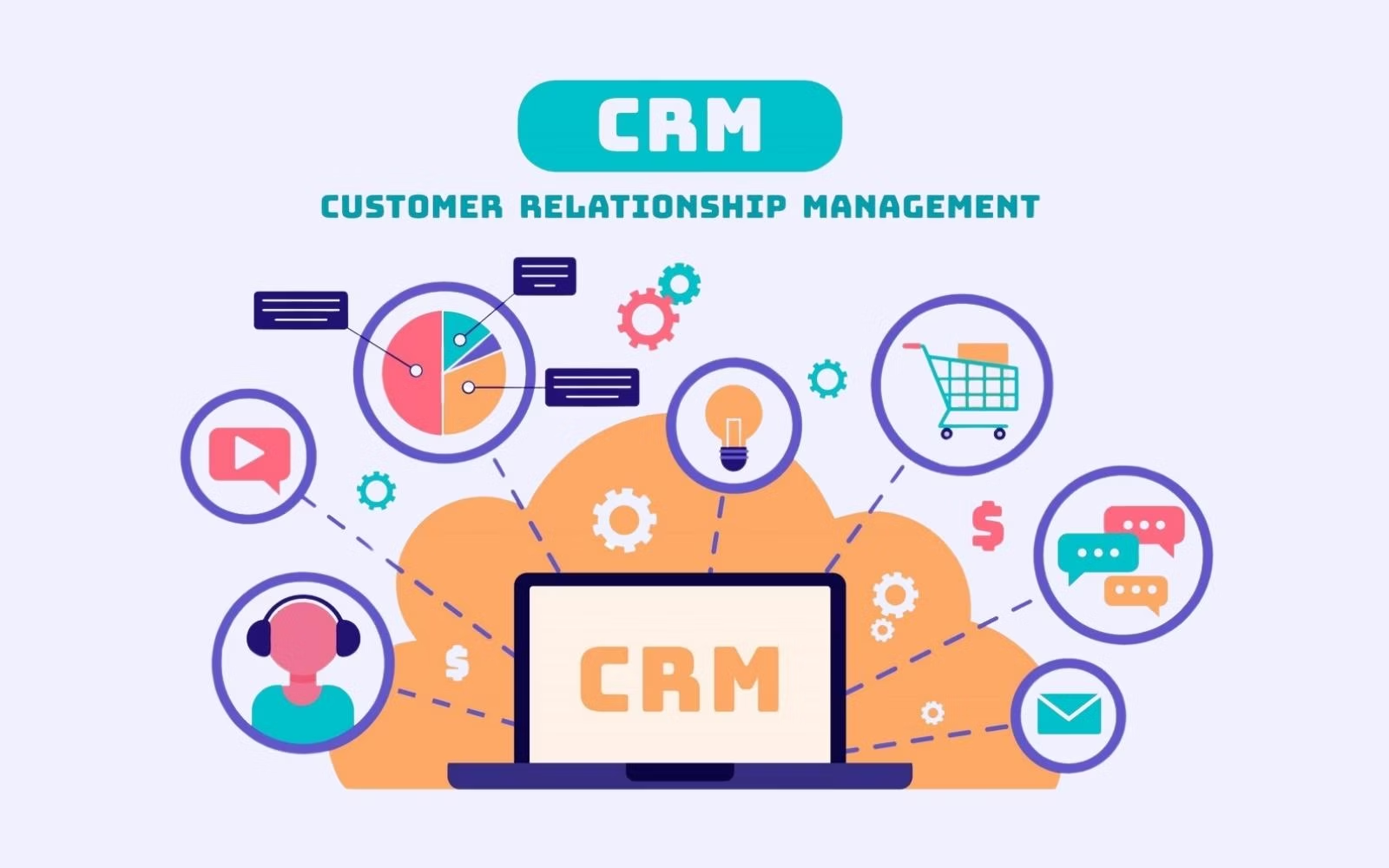
Discover foundational and advanced CRM strategies to boost loyalty and drive growth. Learn how to improve customer relationship management with our expert guide.
Did you know that 76% of consumers get frustrated with generic marketing? In a world crowded with choices, a one-size-fits-all approach to customers just doesn’t work anymore.
Businesses that fail to connect with their audience on a personal level risk losing them. High customer churn, missed opportunities and stagnant growth are the costs of not having a smart plan for managing relationships.
This guide is your complete roadmap. We’ll start with the fundamentals of a customer relationship management strategy, walk you through a step-by-step implementation plan and then explore the advanced strategies used by industry leaders like Salesforce and HubSpot to build lasting loyalty.
A CRM strategy is much more than just the software you use. It’s your company’s master plan for managing every interaction with your customers and potential customers.
Think of it as your North Star. It guides how your sales, marketing and customer service teams work together to create a positive and consistent experience for everyone who engages with your brand.
Your CRM software (like Salesforce or HubSpot) is the tool. Your CRM strategy is the instruction manual.
The strategy dictates your goals, your processes and how you measure success. It puts the customer at the very center of everything you do, shifting your focus from simply closing deals to building genuine, long-term relationships.
At BigBang, we always advise clients to build the strategy first, then choose the technology to support it.
Why invest the time in building a strategy? The results speak for themselves.
A strong CRM strategy directly impacts your bottom line by:
Not all CRM systems are built the same. Understanding the three main types helps you choose the right technology to power your strategy.
This is the most common type of CRM. Its main job is to streamline and automate the day-to-day work of your customer-facing teams.
Think of this as the “brain” of your CRM. An analytical CRM collects, stores and analyzes customer data from all your touchpoints.
Its goal is to give you deep insights into customer behavior, preferences and trends. This is how you achieve that coveted 360-degree customer view, helping you make smarter, data-driven decisions.
A collaborative CRM is all about breaking down silos. It ensures that every department has access to the same up-to-date customer information.
When your marketing team knows a customer recently had a service issue, or your sales team can see which marketing emails a prospect has opened, the customer gets a truly seamless and personalized experience. This is key to building trust.
Also Read: The Ultimate Guide to CRM and ERP Integration
Ready to build your plan? Here’s a straightforward blueprint for how to improve customer relationship management from the ground up.
First, what are you trying to achieve? Your goals must be Specific, Measurable, Achievable, Relevant and Time-bound (SMART).
Don’t just say “we want to improve customer satisfaction.” Instead, say “we will increase our Customer Satisfaction Score (CSAT) by 15% in the next six months.”
How do customers find you, buy from you and interact with you after the sale?
Map out every single step, from their first Google search to their tenth purchase. Identify all the touchpoints where they engage with your brand—your website, social media, email, sales calls and support chats.
You don’t have one type of customer, so you shouldn’t have one message.
Create detailed buyer personas that represent your ideal customer segments. Go beyond basic demographics. What are their goals? What are their pain points? This is the foundation for effective customer segmentation and personalization.
Now that you know your goals and processes, you can choose your tool.
Evaluate leading platforms based on your specific needs.
Your CRM is only as good as the data inside it.
Establish clear rules for data entry to avoid duplicates, outdated information and incomplete records. Your CRM should be the undisputed “single source of truth” for all customer information across the company.
Where can you save your team time? Identify repetitive, manual tasks and automate them.
This could include:
The best CRM in the world is useless if your team doesn’t use it.
Provide comprehensive training that focuses not just on how to use the software, but why it benefits them and the customer. A best practice we follow at BigBang is to identify champions in each department to encourage adoption and provide peer support.
Once you have your foundation in place, you can move on to the advanced strategies that separate the leaders from the pack.
This is where CRM gets really smart. By using AI in CRM, you can move beyond basic personalization.
Your customers don’t just live on email. They are on social media, their phones and your website, often at the same time.
An omnichannel strategy integrates these channels seamlessly. Social CRM tools pull social media conversations into your CRM, while Mobile CRM gives your team access to customer data anytime, anywhere. This creates one unified conversation, no matter how the customer chooses to connect.
For B2B companies, Account-Based Marketing (ABM) is a game-changer. Instead of casting a wide net, ABM treats each target company as its own “market of one.”
Your sales and marketing teams collaborate to create highly personalized campaigns for a small list of high-value accounts. Your CRM is essential for tracking engagement across all key decision-makers within that account.
Your most valuable customers are your existing ones. Advanced CRM strategies focus on increasing retention and CLV.
Use your CRM data to identify your best customers and create exclusive loyalty programs for them. This could include early access to products, special discounts, or dedicated support. Making your top customers feel like VIPs ensures they stay loyal.
Your CRM doesn’t live in a vacuum. It needs to talk to all the other tools you use, from your accounting software to your e-commerce platform.
Using APIs (Application Programming Interfaces) allows you to connect your systems. Platforms like Salesforce have entire marketplaces, like the AppExchange, full of pre-built integrations that create a single, connected technology ecosystem.
Also Read: How NetSuite CRM Will Enhance Customer Engagement in 2025
Let’s look at how the best in the business do it.
Salesforce, led by founder Marc Benioff, didn’t just pioneer SaaS CRM; they perfected it. Their own Sales Cloud is a prime example of an operational CRM that excels at Sales Force Automation. It gives their sales teams a complete view of every customer, automates tasks and provides analytics to forecast sales with incredible accuracy.
HubSpot, co-founded by Brian Halligan and Dharmesh Shah, built its company around the concept of “inbound” marketing—drawing customers in with valuable content. Their CRM is the engine of this flywheel. It tracks every interaction a user has with their content, allowing for incredibly relevant marketing and sales follow-up.
Amazon is a master of analytical CRM. Every click, every search and every purchase you make feeds into their powerful recommendation engine. This deep analysis of customer data allows them to personalize the shopping experience at a massive scale, driving billions in additional revenue.
So, how do you know if your strategy is working? You need to track the right metrics.
Focus on business outcomes, not just activity. Key performance indicators (KPIs) to watch include:
Your CRM should provide you with easy-to-read dashboards. These visuals give you a real-time snapshot of your performance against your KPIs. This allows you to spot trends, identify problems and make quick, informed decisions without waiting for a monthly report.
To understand how you stack up, compare your results to industry benchmarks. Authoritative sources like the Gartner Magic Quadrant for CRM and reports from Forrester Research provide invaluable data on trends, technology and performance standards in your sector.
We’ve covered a lot of ground, from defining a foundational customer relationship management strategy to implementing advanced tactics like AI-driven personalization and ABM.
Remember, a successful CRM strategy is not a one-time project. It’s an ongoing process of listening to your customers, analyzing your data and continuously evolving. Your goal is to move from simply managing contacts to building profitable relationships that last a lifetime.
The best way to start? Take a look at your current processes and see how they measure up against the 7-step blueprint. Your journey to better customer relationships begins today.
Q1: What is the main objective of a CRM strategy? A: The main objective is to place the customer at the center of all business operations. This involves using data, technology and processes to understand customer needs, personalize interactions and build long-term, loyal relationships that drive sustainable growth.
Q2: What are the 3 main components of a CRM strategy? A: The three main components are People, Process and Technology. People refers to training and empowering your team to be customer-centric. The process involves defining standardized workflows for sales, marketing and service. Technology is the CRM software (e.g., Salesforce, HubSpot) that enables and automates these processes.
Q3: Can a small business benefit from a CRM strategy? A: Absolutely. A CRM strategy is crucial for businesses of all sizes. For small businesses, it helps organize customer data, automate repetitive tasks and ensures no leads or customer issues fall through the cracks, allowing them to compete effectively and build a loyal customer base from the ground up.
Get a free assessment from our cloud experts and map out your roadmap.
Get my free assessment